FOOTPRINTS OF HISTORY – MIRAVET
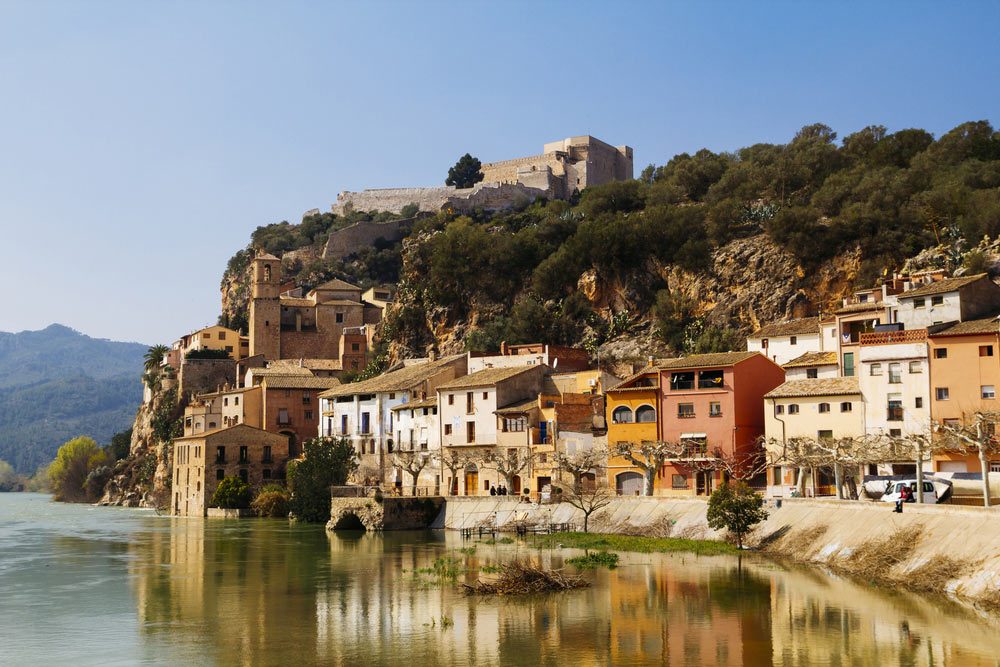
The village of Miravet, located in the Ribera del Ebro, is a place well worth visiting. A tourist enclave full of history and with many interesting sites.
Due to its location on the banks of the Ebro River, it has always been a highly contested place. In its beginnings it was an Iberian settlement, it was also part of Muslim rule, and later the Knights Templar conquered the territory. Its role in the Battle of the Ebro during the Spanish Civil War is also noteworthy.
It is a walled town with constructions at different levels, houses hanging from the mountain and cliffs above the Ebro River. Walking through the old town, known as Cap de la Vila, you can see arcaded streets, charming houses, vegetation and spectacular views. You can also observe the traces left by the Battle of the Ebro in destroyed and abandoned houses.
A highly recommended activity in Miravet is crossing the Ebro River on the last remaining ferry crossing. It is the last non-motorized river ferry on the entire Ebro. It consists of two boats joined by a platform that can carry a maximum of three cars. The ferry operates using the force of the water.
The most prominent monument is the Castle, which after the Muslim period became a Templar fortress. It is located on a hill from where the entire territory was controlled. Despite having experienced several wars, it is very well preserved, as can be seen during the guided tours.
About 20 minutes from Miravet is Benifallet, where you can visit the Wine Cathedral of Pinell and the Benifallet Caves, which together with the Castle make up the so-called route of the 3 “C’s”.
The Wine Cathedral of Pinell is a modernist cooperative winery where oil and wine with the Terra Alta designation of origin are produced.
In Benifallet you can visit two caves: Cova Meravella and Cova del Dos. The visits are guided and last around 45 minutes. These are caves with extraordinary formations.
- Cova Meravella is characterized by the large number of eccentric formations created by the slow and constant dripping of water. It is made up of 3 chambers:
- Llapis Hall: the ceiling is full of fine stalactites and the floor has a curtain of stalagmites.
- Amphitheatre Hall: there are circular pools resembling the tiers of an amphitheatre.
- Music Hall: in this chamber you can observe all formations: stalactites, stalagmites, columns, flags, etc.
- Cova del Dos: inside there are historical remains from the Neolithic period and the Battle of the Ebro.
“Man has no nature, only history” – José Ortega y Gasset